Submesoscale Fronts
Assessed how well a multi-decadal Gulf of Mexico circulation model reproduces submesoscale frontal eddies in the Mississippi/Atchafalaya plume, and what drives their variability.
The Challenge
River plume fronts on the Texas-Louisiana shelf generate strong submesoscale instabilities important for cross-shelf exchange, but it was unclear whether a regional circulation model could reproduce these features accurately enough to trust for process studies.
The Approach
Ran a multi-decadal ROMS simulation of Gulf of Mexico circulation and validated it against multi-year, densely-sampled CTD and velocity observations, comparing eddy kinetic energy and salinity-gradient statistics between model and observations.
The Result
Published in Ocean Dynamics (Kobashi & Hetland, 2020) — the model reproduced observed frontal eddy magnitude and statistics well; seasonal/inter-annual variability was tied to river streamflow and wind stress, with decadal-scale correlation to Mississippi River outflow.
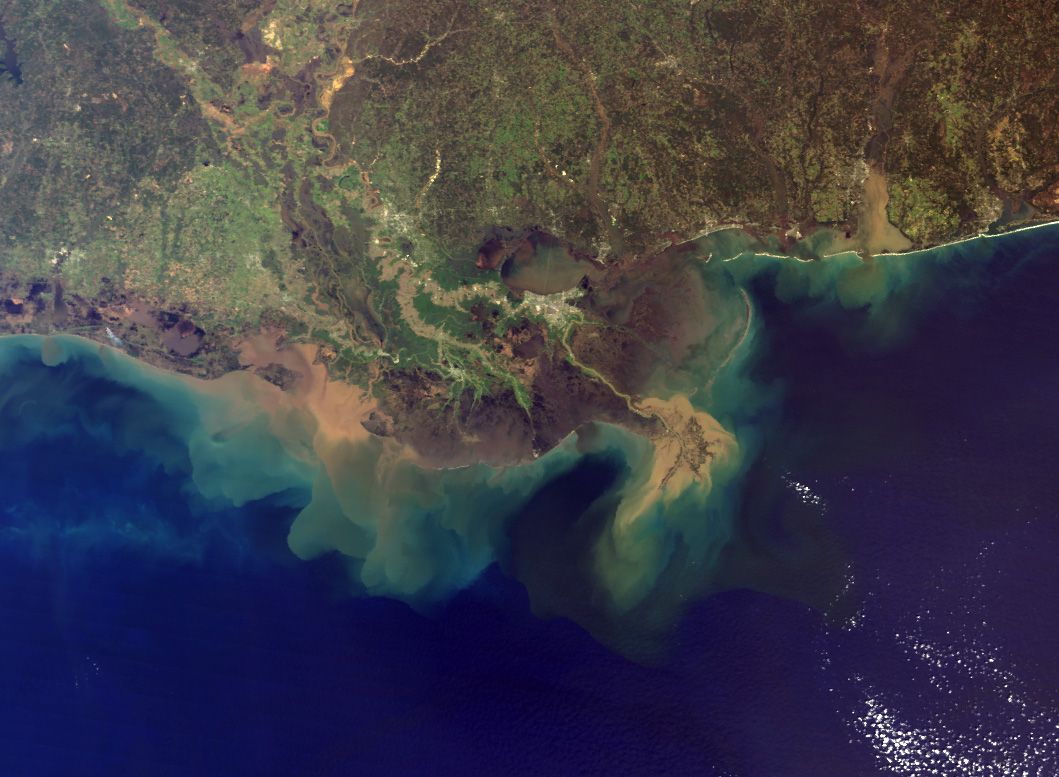
Thumbnail: Mississippi River sediment plume, MODIS/Terra — public domain (NASA Earth Observatory, Liam Gumley/MODIS team).